
Article published on July 5, 2026, on France 3 Normandie – France Info | By Karine Lepointeur
The collections of the future Museum of War Captivity continue to grow. Diaries, personal items, photographs… These are all unique artifacts that shed light on the lives of prisoners in camps such as the one at Foucarville, now a borough of Sainte-Mère-Eglise. It held up to 100,000 Germans during World War II.
It all began with Anne Broilliard and Benoît Lenoël, two curious locals with a passion for history. In 2017, they shared the results of their research on the Foucarville camp in a book titled *German Prisoners in Normandy: An American Camp in Foucarville*.
While writing this book, Anne Broilliard befriended Alice Kennedy, the daughter of the camp commander, who gradually began sending her father’s personal items and archives with the aim of displaying them in a future permanent museum. But to tell the story of CCPWE19—the Continental Central Prisoner of War Enclosure No. 19—it was also necessary to collect artifacts and testimonies from prisoners.
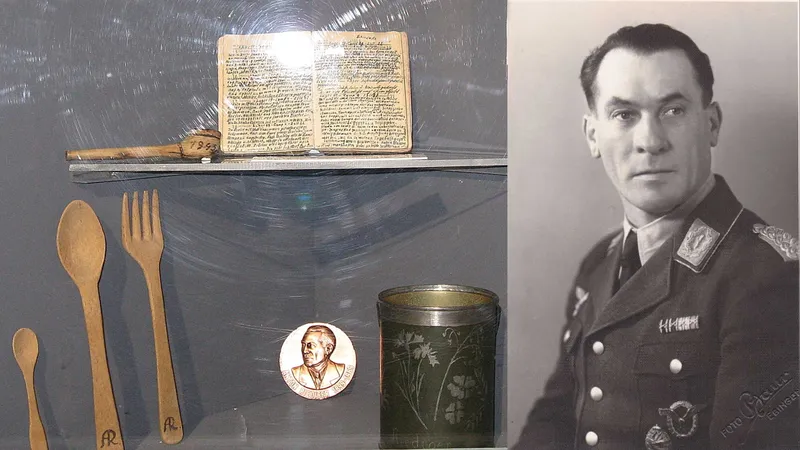
“A few German prisoners returned to Foucarville after the war,” says Anne Broilliard, “but I didn’t know them. They sometimes came with their descendants. That’s how, little by little, we got in touch with them, but it was a long way from there to them deciding to donate what they had—it was complicated for them.”
Yet, after many discussions, some families finally make up their minds. “For them, it was the only way to ensure the legacy would live on and that their father would be honored,” says Anne Broilliard. “The descendants are glad that people are interested in their parents and that they aren’t being labeled as Nazis.”
A seashell collected at Utah Beach in 1945 that had been brought back from Germany
About 100,000 German prisoners passed through the Foucarville camp. They included soldiers, high-ranking officers, and 17,000 young people under the age of 18. The youngest was only 12 years old.
Hans-Dieter Nüdling was 16 years old when he was drafted into the FLAK, the German anti-aircraft defense force. Two years later, in 1945, he arrived as a prisoner at CCPWE19. During the day, he helped build the Utah Beach Memorial, which can still be seen today in the dunes along the beach, a few kilometers from the camp.
“We could smell the sea and see the water of the bay as a silvery streak on the horizon. Despite the physical labor that quickly burned through our 900 daily calories, I felt as though these missions were excursions into the freedom of an unknown coastal landscape—rugged yet magnificent.”
Excerpt from the diary of Hans-Dieter Nüdling, a German prisoner of war, during the construction of the Utah Beach Memorial in 1945