
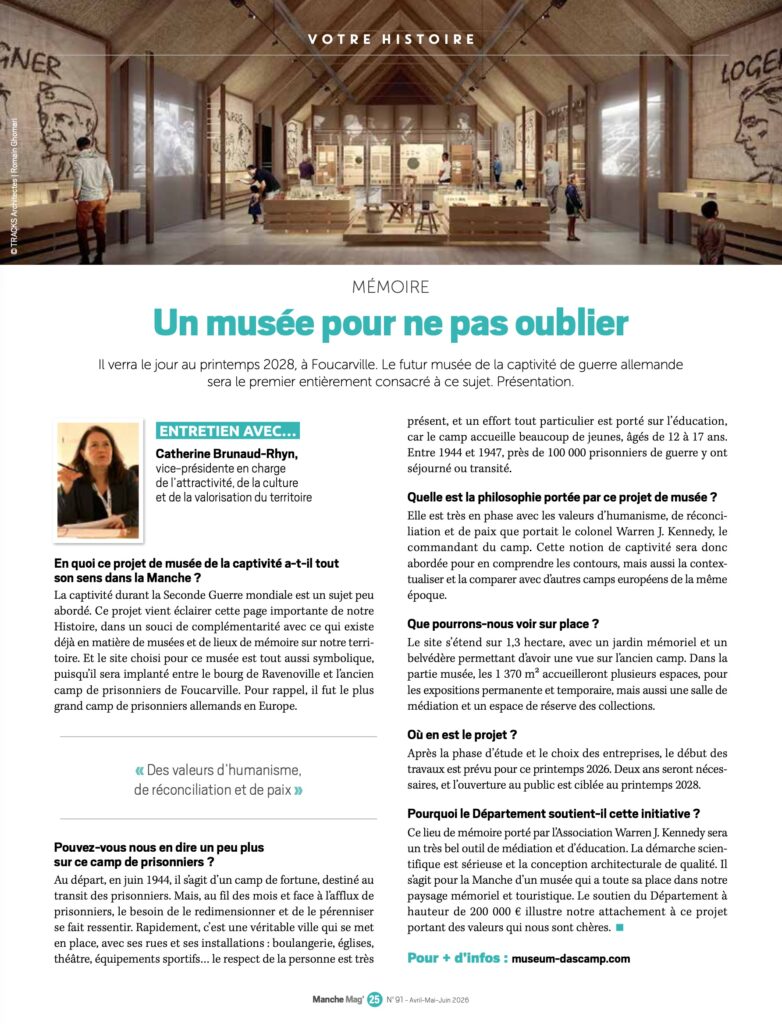
It will open in spring 2028, in Foucarville. The future museum of German war captivity will be the first entirely dedicated to this subject. To find out more.
Article published in Manche’Mag April 2026
INTERVIEW WITH…
Catherine Brunaud-Rhyn, Vice-President in charge of Attractiveness, Culture and Territorial Development
Why does this captivity museum project make so much sense in La Manche?
Captivity during the Second World War is a little-talked-about subject. This project will shed light on this important page in our history, complementing the existing museums and memorial sites in the area. And the site chosen for this museum is just as symbolic, as it will be located between the town of Ravenoville and the former Foucarville prison camp. This was the largest German prison camp in Europe.
Can you tell us a little more about this prison camp?
Initially, in June 1944, it was a makeshift camp for the transit of prisoners. But as the months went by and the number of prisoners increased, the need arose to resize the camp and make it permanent. It quickly became a real town, with its own streets and facilities: bakery, churches, theater, sports facilities… respect for the individual was very much in evidence, and a special effort was made to provide education, as the camp welcomed many young people aged 12 to 17. Between 1944 and 1947, almost 100,000 prisoners of war stayed or passed through the camp.
What is the philosophy behind this museum project?
It is very much in line with the values of humanism, reconciliation and peace espoused by Colonel Warren J. Kennedy, the camp commander. This notion of captivity will be explored to understand its contours, but also to contextualize it and compare it with other European camps of the same era.
What can we see on site?
The site extends over 1.3 hectares, with a memorial garden and a belvedere offering a view of the former camp. In the museum section, the 1,370 m² will house a number of spaces for permanent and temporary exhibitions, as well as a mediation room and a collection storage area.
How far along is the project?
Following the study phase and the selection of contractors, work is scheduled to start in spring 2026. It will take two years to complete, with opening to the public targeted for spring 2028.
Why is the Département supporting this initiative?
This place of remembrance, supported by the Warren J. Kennedy Association, will be an excellent tool for mediation and education. The scientific approach is sound, and the architectural design of high quality. For the Manche region, this is a museum that has a rightful place in our landscape of remembrance and tourism. The Department’s support of €200,000 illustrates our attachment to this project, which reflects the values we hold dear.